
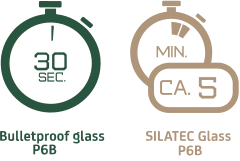
Conventional P6B glass can be destroyed in a few seconds. SILATEC P6B glass in contrast easily withstands the hits for many minutes3. Because the patented design principle of SILATEC is basically different: With polycarbonate and a cleverly devised combination of most resistant and impact resisting materials.
View the burglary test:
P6B glass vs. SILATEC P6B glass
80% of the burglars come through the window. Therefore, your house would be safer if it were covered by walls all around. This is why we invented walls of glass. Burglary resisting P6B2 glass by SILATEC converts your mansions into a fortress. As display windows, galleries or museums. The P6B glazing is a burglary resisting glazing in accordance with the European standard EN 356. An even larger protection is offered by our P7B or P8B glazing.
Tests and standards are good. But the practical use is even more important: And this is where SILATEC proves itself with approximately one thousand successfully prevented burglary attempts worldwide during the last ten years. A spectacular case is the burglary attempt at the headquarters of the jeweler Bulgari, in the center of Rome, on Via Condotti. Two burglars steal in broad daylight a heavy tow truck and drive it in reverse gear into the display window of the top jeweler. Into the display window - but not through the display window. Because the wall of glass stands! The glass splinters, but the completely surprised burglars see immediately: there is no pass-though here. They flee, but they are later arrested.
The difference: Polycarbonate. Because P6B glass is available with or without this impact resisting material. Of course, SILATEC P6B glass includes polycarbonate, because we take this subject seriously. No question. Its outside areas consist of glass - and the core is polycarbonate. Special SILATEC adhesives and selected transparent materials are added. The advantage: P6B2 glass with polycarbonate offers much more burglary protection than conventional armored glass and therefore it has deserved the designation “burglary resisting glass”. In addition, it weighs significantly less, which means that windows and doors can be easily opened.

 SILATEC P6B glass with polycarbonate core
Glass - polycarbonate - glass
Conventional P6B glass in contrast is simple. Several glass panes are connected with a foil. Done. The thicker the package the more resistant it is against hammering-in. However, it is heavier and - based on the own coloring of the glass - also more green tinted. And despite the fact that these green chunks are so thick and heavy: They do not reach the impact resistance of SILATEC P6B glass - they do not even come close.

 conventional P6B glass
SILATEC P6B glass is available with a glass thickness starting at approx. 16mm. The glass thickness is a minimum of about approx. 28 mm for a double glazing with improved heat insulation. P6B glass with triple insulation glass with a glass thickness starting at approx. 40 mm insulates even better. The listed glass thicknesses increase depending on the format, because large panes must - for static reasons - of course be designed thicker, however, they are still much thinner than conventional P6B glass.
The price for P6B glass depends on how many minutes the glazing prevents that a hole can be beaten into the pane. For example, with an ax or a sledgehammer.
Conventional P6B glass (normal “armored glass”), into which a hole can be beaten in less than half a minute, costs approx. 300 EUR/m2 net and higher. This represents costs of approx. 600 EUR/m2 per minute of protection
SILATEC P6B into a hole cannot be beaten in approx. 10 minutes3, neither with an ax nor with a sledgehammer, costs approx. 600 EUR/m2 and higher. This represents costs of approx. 60 EUR/m2 per minute of protection.
Approx, 20% to 30% must be added for double insulation glass for heat protection or sun protection. Triple insulation glass costs an addition of approx. 20%, but it reduces the energy losses in winter by approx. 30% if compared to double insulation glass.
Price comparison
Traditional P6B glass (armored glass): approx. 600 EUR/m2, per minute protection against hammering-in SILATEC P6B glass: approx. 60 EUR/m2, per minute protection against hammering-in
SILATEC P6B glass is especially qualified for burglary resisting windows in private residences with the burglary protection class RC2 window and RC3 window. SILATEC P8B2 glass is recommended for the protection of especially exposed risks. For example in RC4 - RC6 windows. The reason for this allocation is as simple as it is logical: safety glass and window frame should be similarly resistant - because the safest glass only protects you if the frame also resists.

RC2 windows stop the amateur culprit with small tools (e.g. screwdrivers) for approx. 3 minutes. It is obvious that the glazing should also resist for approx. 3 minutes. Therefore, it is recommended to use at least P6B glass. However: The burglary test for windows does not even attack the glass. Yes, you read that right. The glass pane will not be attacked! The standard only recommends to install P4A glass. However, this can be destroyed in a few seconds.
The same holds true for RC3 windows. RC3 windows resist a burglar with average talent and equipped with a crowbar for approx. 5 minutes. It is recommended to install here at least Silatec P6B2 glass to ensure that window frame and glass provide a uniform protection effect. The standard views this different: The glass will not be tested. Unbelievable, but true. Only P5A glass is requested. However, anybody can destroy P5A glass quickly in a few seconds.
The same is also true for RC4, RC5 and RC6 windows. Our recommendation2: Glass and window frame must be similarly safe. Therefore, the following glass recommendations apply for burglary resisting RC2 to RC42 windows.
Delivery program for SILATEC P6B glass
| Type | Name | Dimensions max. [mm] | Thickness [mm] | Weight [kg/m2] | U* [W/m2K] | & | TL* [%] | g* [%] | Rw [dB] | Options | Tc | ||
|---|---|---|---|---|---|---|---|---|---|---|---|---|---|
| AS | AW | Sus | |||||||||||
| (mm) (kg/m2) | They depend on the size of the pane, the loads (e.g. wind load) as well as guidelines and regulations |
| mono, i2, i3 | monolithic, insulating glass, triple insulating glass |
| U | Thermal transfer coefficient. The smaller the value, the better the heat insulation. |
| Kr | Krypton |
| Ar | Argon |
| TL | Translucence. A larger value means that more light transfers through the glazing |
| g | Total energy permeability. A smaller value means that less energy transfers through the glazing. |
| Rw | Sound insulation measure. The larger the value, the better the sound insulation. The listed values are based on a Krypton filling. |
| AS | Alarm loop. Visible or invisible. |
| AW | Alarm wire |
| SuS | Sun protection coating |
1) | Test certificate |
All values are subject to the common tolerances. Adherence to our special glazing guideline is required.
This delivery program shows our established products. We produce in addition also nonstandard special solutions. Please ask us.
We reserve the right to change the technical information, changes in the delivery program as well as changes of our references. Adherence to the legal regulations is required for all applications. Adherence to our special glazing guidelines is required, because our warranty is otherwise canceled.
When in doubt, please contact us.
P6B glazing can be equipped with alarm glass in addition to the mechanical burglary protection. An alarm loop will in this case be burned into the P6B glass. The alarm loop will be severed and an alarm will be triggered via the connected alarm system if an attack on the glass pane is taking place. Two variants are available: The visible alarm loop has a size of about 50 mm and is located in a corner of the alarm glass. The invisible alarm loop is burned in at the extreme edge of the P6B alarm glass and it disappears optically in the window frame. It is not visible to the observer.
The heat insulation of a monolithic P6B glazing with a U-value of approx. 4.6 W/m2K is comparably bad. This comes with a thickness of only approx. 16mm. The heat protection of the P6B pane with double insulation glass improves to a U-value of approx. 0.9 to 1.3 W/m2K. The heat protection for triple glazed P6B panes improves to a U-value of approx. 0.5 to 0.7 W/m2K. A smaller value means that less energy transfers through the glazing.
Where does P6B glass by SILATEC protect?


This is where you will get all the information about P6B glass
P6B glass
This is where you will get all the information about P7B glass
P7B glass
This is where you will get all the information about P8B glass
P8B glass
This is where you will get all the information about P2A glass
P2A glass
This is where you will get all the information about P4A glass
P4A glass
This is where you will get all the information about P5A glass
P5A glassFAQs
What is better: P6B glass or P4A glass?
P6B glass does provide burglary protection. P4A provides hardly any. P6B glass is tested brutally with an ax. The test for P4A glass includes only an approx. 4 kg heavy steel ball that is dropped on the glass pane. The P4A glass can prevent that, for example, a stone will be thrown through the pane. However, the P4A glass provides hardly any burglary protection.
How is P6B glass tested?
P6B glass is tested with an ax. The ax is fastened to a machine and hits accurately down to a millimeter and with a defined force on the P6B glass. Decisive for the burglary resisting classification as per EN 356 is the number of hits to achieve an opening with a size of 400 x 400 mm. If at least 30 ax hits are required, then the glazing receives the certificate P6B glass. It receives the certification P7B starting with 51 hits and P8B starting with 71 hits.
Does P6B glass have any UV protection?
SILATEC P6B glass with polycarbonate offers UV protection4. Conventional armored glass does not provide UV protection.


Other products